If you are working out how to choose a chef’s knife, start with how you cook, then pick a style, a steel and a length that suit it. For most home cooks that means deciding between a heavier German-style knife that shrugs off abuse and a thinner, harder Japanese-style blade that slices with precision but needs gentler handling. Then hold a few. Comfort and balance in your own hand matter more than any spec sheet.
A good chef’s knife does most of the work in a home kitchen: onions, herbs, squash, a whole chicken. Buy the right one and it will last for decades. Buy the wrong one and it lives in the drawer while you reach for a paring knife.
This guide walks through each decision in order, with a comparison table and a realistic look at what spending more actually gets you. There are no shopping links, just the criteria.
Key takeaways
- German-style knives are thicker, heavier and more forgiving; Japanese-style knives are thinner, harder and sharper, but can chip.
- Hardness is measured on the Rockwell C scale: German blades sit around 57, Japanese blades often 60 to 63.
- Stainless steel contains at least 10.5% chromium; carbon steel takes a keen edge but rusts if neglected.
- An 8-inch (20 cm) blade suits most home cooks; go shorter for small hands or small boards.
- Hold before you buy. Grip comfort, balance and weight decide whether you’ll actually use it.
In this guide
- German or Japanese: the two big styles
- Steel and hardness, without the jargon
- Length, shape, handle and balance
- Budget tiers: what your money buys
- Care and sharpening
- FAQ
- Your next step
German or Japanese: the two big styles
Almost every chef’s knife you’ll see falls into one of two families, and the choice between them shapes everything else.
| German style | Japanese style | |
|---|---|---|
| Typical hardness (HRC) | Around 57 | About 60 to 63 |
| Blade | Thicker and heavier | Thinner and lighter |
| Profile | Curved belly for a rocking cut | Flatter, for push and pull slicing |
| Edge | Wider angle, symmetrical | More acute; traditional blades are asymmetrical |
| Strength | Tough and forgiving, holds up to hard use | Holds a keen edge longer |
| Weakness | Needs honing and sharpening more often | More brittle, can chip on bones or frozen food |
| Best for | Heavy-handed cooks, mixed tasks, rocking choppers | Precise slicing, vegetables, cooks who baby their tools |
The figures above come from Tasting Table’s comparison of the two styles, which describes German knives as utilitarian workhorses with rounded bellies and Japanese knives as thinner blades built for precision. It also notes that traditional Japanese blades are sharpened asymmetrically, often 70/30 for right-handed cooks, while German edges are symmetrical and work for either hand. Many Japanese brands sold abroad now offer symmetrical edges too, which matters if you’re left-handed.
A quick way to decide
- You chop by rocking the blade and sometimes hack through chicken joints: lean German.
- You mostly slice vegetables and fish and like a light knife: lean Japanese.
- You’re not sure: a Western-shaped knife made from harder Japanese-style steel sits in the middle and is a popular first upgrade.
Steel and hardness, without the jargon
Knife marketing is full of steel names and numbers. Two ideas cover most of what you need to know: hardness and corrosion resistance.
What the Rockwell number means
Knife hardness is usually quoted on the Rockwell C scale, written as HRC. According to the National Institute of Standards and Technology, a Rockwell test presses an indenter into the metal at two levels of force and calculates hardness from the difference in how deep it goes. The C scale uses a diamond indenter and is used for hard materials such as hardened steel.
For a cook, the trade-off is simple. A higher number generally means a blade that holds a fine edge longer; a lower number means a tougher blade that is less likely to chip and easier to bring back with a honing steel. Neither is better in the abstract. It depends on how you treat your knives.
Stainless, carbon and in between
- Stainless steel. The stainless steel industry association worldstainless defines stainless steels as corrosion-resistant steels with a minimum of 10.5 percent chromium. That chromium is what lets a knife sit wet for a few minutes without spotting. Most home knives are stainless.
- Carbon steel. Takes a very keen edge and is easy to sharpen, but it will rust and develop a grey patina. Wipe it dry after every use.
- Clad or layered blades. A hard core steel wrapped in softer or stainless outer layers, sometimes with a decorative pattern. The pattern is cosmetic; the core steel is what cuts.
The best chef’s knife is the one that feels like part of your hand at the end of a long prep session.
Length, shape, handle and balance
Blade length
Chef’s knives typically run from about 6 to 10 inches. For most home cooks, 8 inches (roughly 20 cm) is the sweet spot: long enough to slice through a large onion or a cabbage in one stroke, short enough to control on an average cutting board.
- 6 to 7 inches. Good for small hands, small kitchens and cooks who feel nervous with a big blade.
- 8 inches. The all-rounder, and the best starting point if you’re only buying one.
- 9 to 10 inches. Great for big batches and large boards, but can feel unwieldy on a narrow counter.
Blade shape
Shape matters too. A curved belly suits a rocking motion; a flatter edge suits push cuts where the whole edge meets the board. Look down the length of the blade and imagine your usual cutting motion. The knife should suit that motion, not force a new one.
The in-hand test
Specs only get you so far. The in-hand test is where you make the real decision, so try to hold a knife before you buy it.
- Use a pinch grip. Pinch the blade just ahead of the handle between thumb and the side of your index finger, with the other fingers wrapped around the handle. This is how you’ll actually hold it.
- Find the balance point. Rest the knife on one finger near where the blade meets the handle. A point near the heel feels neutral and controlled; a point further forward feels blade-heavy and does more of the work on hard vegetables.
- Check the heel and spine. Run your finger along the top of the blade and the heel. Sharp, square edges here will rub your hand raw over a long prep session.
- Mime a few cuts. Rock it, push it, and check that your knuckles clear the board when the edge is flat.
- Notice the weight. A heavy knife feels powerful for a minute and tiring after twenty. A very light one can feel flimsy. Pick what feels good over a whole dinner, not a single slice.
Handles come in wood, composite and plastic. Wood looks lovely but needs to stay out of the dishwasher and should be dried promptly; composite and plastic are the low-maintenance choice. Full bolsters, the thick collar where blade meets handle on many German knives, add weight and protect your fingers, but they can make sharpening the back of the edge harder.
Budget tiers: what your money buys
You don’t need to spend a fortune, but price does buy real differences. Think in tiers rather than specific numbers.
- Entry level. A stamped stainless blade, plastic or composite handle and lighter weight. Suits first kitchens, students, or a knife to lend.
- Mid-range. Better steel, tighter fit and finish, often a forged German or Western-Japanese design. The best value for most home cooks.
- Premium. Harder specialty steels, hand finishing, clad blades and fine grinds. Worth it for keen cooks who hone, sharpen and hand-wash.
A mid-range knife that you keep sharp will outperform a premium knife that you let go dull. If your budget is limited, spend it on a decent knife plus a way to keep it sharp rather than on a fancier blade alone. Our kitchen gear guides cover the rest of your basic toolkit, including choosing a cutting board.
Care and sharpening
Good care matters more than the price tag. These habits will keep any chef’s knife cutting well for years.
- Hand wash and dry it straight away. Dishwashers knock blades against other items and are hard on wooden handles. Don’t leave the knife sitting in a sink of water.
- Use a forgiving board. Wood or plastic boards are kind to an edge. Glass, marble and stone boards dull it quickly.
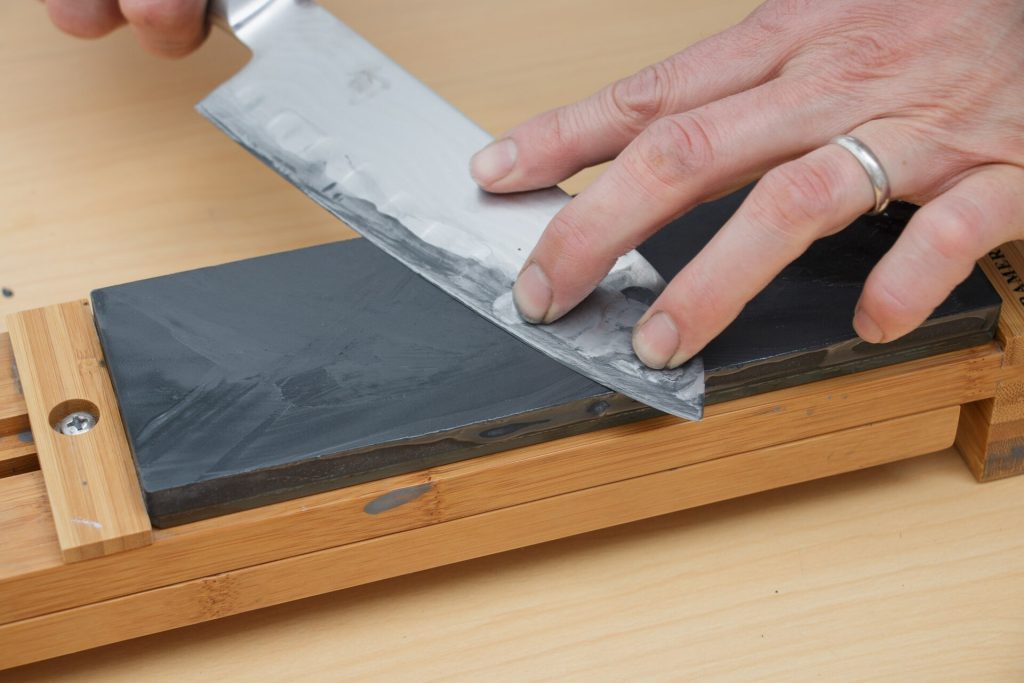
- Hone often, sharpen occasionally. A honing steel realigns a softer German edge between sharpenings. Harder Japanese blades are better maintained on a fine whetstone or ceramic rod, since they can chip on a grooved steel.
- Store it safely. A magnetic strip, a block or a blade guard protects both the edge and your fingers. Loose in a drawer is the fastest way to dull it.
- Match the task. Don’t use a thin Japanese blade on bones, frozen food or hard squash rinds. That’s what a heavier knife or a cleaver is for.
If you’re new to whetstones, our walkthrough on sharpening a knife at home covers the basics step by step.
FAQ
What size chef’s knife should a beginner buy?
An 8-inch blade is the most versatile choice. If you have small hands or a small board, a 6- or 7-inch knife will feel more controllable.
Is a harder knife always better?
No. Harder steel holds an edge longer, but it’s more brittle and can chip. Softer German-style steel is tougher and easier to touch up with a honing steel.
Are Japanese knives good for left-handed cooks?
Traditional Japanese blades are often sharpened asymmetrically for right-handers. Look for a symmetrical edge, which many Japanese brands now offer, or ask for a left-handed grind.
Can a chef’s knife go in the dishwasher?
It’s best not to. Hand washing and drying protects the edge and the handle and takes less than a minute.
Your next step
Before you buy, spend five minutes watching how you cut: do you rock or push, and do you tackle bones and squash? Write down your answer, set a budget tier, and go hold three knives that fit it. The one that feels right after a minute of mime-chopping is your knife. For more ways to put it to work, browse our recipes.
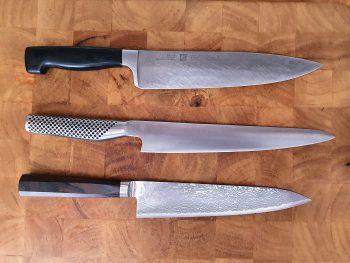
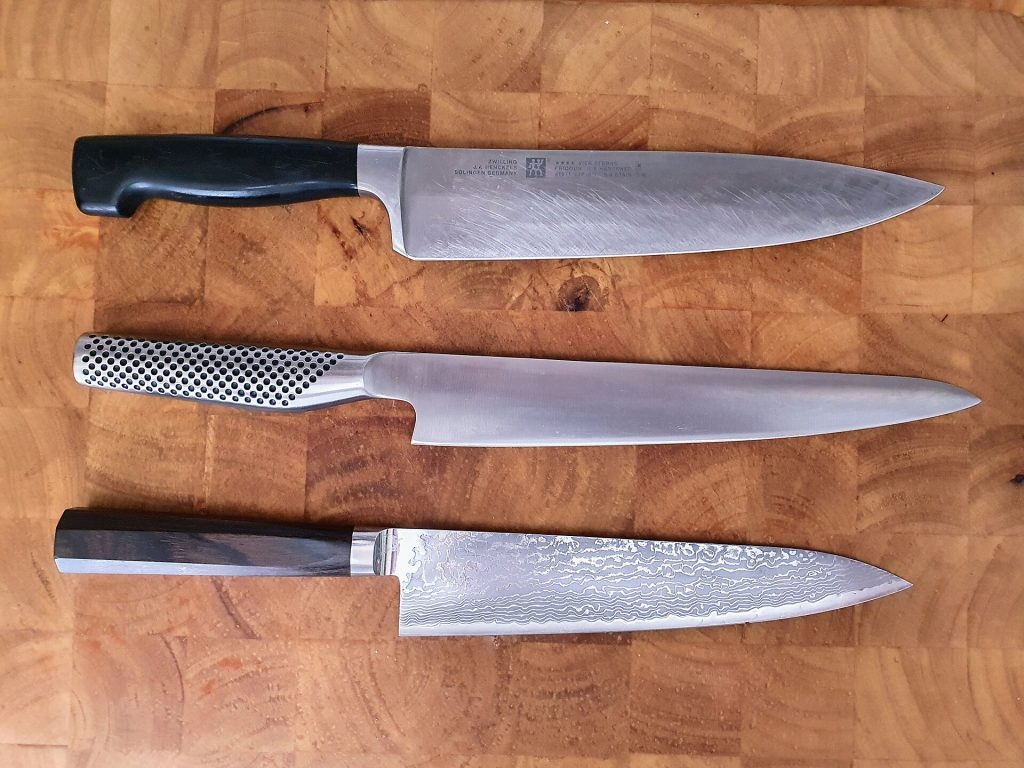
Featured photo: Chefs knifes on a wooden cutting board by T. Bjornstad, BY-SA 4.0.