
Most adults need somewhere between 25 and 38 grams of fiber a day. Health Canada sets the target at 25 grams for women and 38 grams for men, and the U.S. Dietary Guidelines benchmark works out to 14 grams for every 1,000 calories you eat, which is about 28 grams on a 2,000-calorie day.
If your daily fiber intake sits well below that, you are in good company. Most of us eat roughly half of what we should, and the fix is rarely a supplement or a strict plan. It is a handful of small swaps at breakfast, lunch, dinner and snack time.
This guide explains where the numbers come from, which everyday foods carry the most fiber per serving, and how to build a day that actually hits the target without turning your kitchen upside down.
Key takeaways
- Health Canada recommends 25 g of fiber a day for women and 38 g for men.
- The U.S. benchmark is 14 g per 1,000 calories, about 28 g on a 2,000-calorie diet.
- Americans averaged just 8.1 g per 1,000 calories in 2017–18, around 58% of the target.
- Beans, lentils, split peas, raspberries and whole grains do the heavy lifting.
- Add fiber gradually over a few weeks and drink plenty of fluids as you go.
The numbers behind a healthy fiber target
There are two common ways to express the goal. Canada uses a flat daily amount: 25 grams for women and 38 grams for men. The American approach scales with how much you eat. USDA’s Economic Research Service measures U.S. diets against the Dietary Guidelines recommendation of 14 grams per 1,000 calories.
Both land in a similar place for most adults. Someone eating 2,000 calories needs about 28 grams on the U.S. measure. Someone eating 2,700 calories needs about 38 grams, which lines up neatly with the Canadian figure for men.
How far short most people fall
The gap is real on both sides of the border. Health Canada notes that most Canadians get only about half the fiber they need. In the U.S., the ERS found that diets averaged 8.1 grams per 1,000 calories in 2017–18, or 58 percent of the recommendation.
What the newest guidelines say
The 2025–2030 Dietary Guidelines for Americans do not print a gram target of their own. Instead they tell you to “prioritize fiber-rich whole grains,” to eat vegetables and fruits whole and in their original form, and to cut back on highly processed, refined carbohydrates. The practical message is the same: more plants, less white flour.
Why fiber earns a place on your plate
Fiber is the part of plant foods your body does not fully digest, and that is exactly why it is useful. According to Health Canada, fiber may help with three things:
- Keeping your bowels regular.
- Lowering blood cholesterol levels.
- Helping you feel full for longer.
The newest U.S. guidelines add that vegetables, fruits, fermented foods and high-fiber foods support a diverse gut microbiome. You do not need to chase any single benefit. Eating more whole plant foods tends to bring all of them along together.
You do not need a fiber supplement to hit your target. You need beans in the pot and the skin left on the apple.
The foods that do the heavy lifting
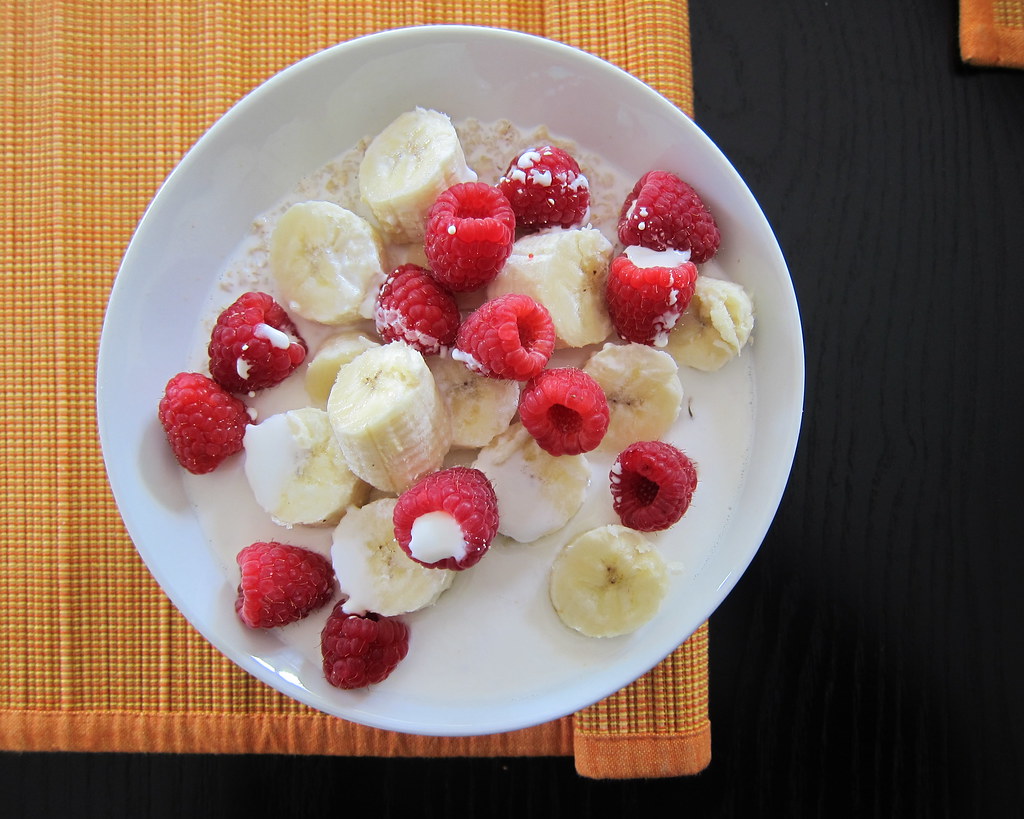
Not all fiber sources are equal. A slice of whole-wheat bread gives you about 2 grams, while a cup of cooked lentils gives you more than seven times that. The figures below come from the Mayo Clinic’s high-fiber food chart, which draws on the USDA National Nutrient Database for Standard Reference.
Legumes: the fiber heavyweights
- Split peas, boiled: 16 g per cup
- Lentils, boiled: 15.5 g per cup
- Black beans, boiled: 15 g per cup
- Cannellini, navy or great northern beans, canned: 13 g per cup
Fruit and vegetables
- Raspberries: 8 g per cup
- Green peas, boiled: 9 g per cup
- Pear: 5.5 g per medium fruit
- Apple with skin: 4.5 g per medium fruit
- Broccoli, boiled: 5 g per chopped cup
Grains, nuts and seeds
- Whole-wheat spaghetti or pearled barley: 6 g per cooked cup
- Quinoa: 5 g per cooked cup
- Brown rice: 3.5 g per cooked cup
- Chia seeds: 10 g per ounce
- Almonds: 3.5 g per ounce (about 23 nuts)
Easy swaps to raise your daily fiber intake
The fastest way to eat more fiber is to change what is already on your plate rather than add whole new meals. Each swap below trades a lower-fiber habit for a food with a sourced fiber count.
| Meal | Instead of | Try | Fiber in the swap |
|---|---|---|---|
| Breakfast | Plain oatmeal | 1 cup instant oatmeal topped with 1 cup raspberries | 12 g (4 g + 8 g) |
| Breakfast | Low-fiber cereal | 3/4 cup bran flakes | 5.5 g |
| Lunch | A sandwich on its own | Add 1 cup canned cannellini beans to a side salad | 13 g |
| Dinner | Brown rice | 1 cup cooked pearled barley | 6 g (vs 3.5 g) |
| Dinner | Regular spaghetti | 1 cup whole-wheat spaghetti | 6 g |
| Side dish | Plain potatoes, peeled | 1 medium baked potato with skin | 4 g |
| Snack | Chips | 3 cups air-popped popcorn | 3.5 g |
| Snack | Juice | A medium pear or apple with skin | 5.5 g or 4.5 g |
Small kitchen habits that add up
- Leave the skins on potatoes and apples when you can.
- Keep a couple of cans of beans in the pantry and rinse them into soups, salads and pasta sauces.
- Stir chia seeds into yogurt or overnight oats.
- Bulk up a bolognese or chili with a cup of lentils.
- Cook a big pot of barley or quinoa at the weekend and use it all week. Our guide to batch cooking for the week shows how.
A sample day that reaches 38 grams
Here is what a higher-fiber day can look like using only the foods and portions listed above. It is not a diet plan, just proof that the target is reachable with ordinary meals.
- Breakfast: 1 cup instant oatmeal with 1 cup raspberries (12 g).
- Mid-morning: a medium pear (5.5 g).
- Lunch: 1 cup whole-wheat spaghetti tossed with 1 cup boiled broccoli (11 g).
- Afternoon: 1 ounce of almonds (3.5 g).
- Dinner: half a cup of boiled black beans in tacos or a rice bowl (7.5 g).
That adds up to 39.5 grams, enough for the Canadian target for men and well over the 25 grams recommended for women. Drop the almonds and the pear and you are still at 30.5 grams.
Go slowly and drink up
If you currently eat very little fiber, do not jump to 38 grams tomorrow. The Mayo Clinic warns that adding too much too quickly can cause gas, cramping and bloating, and suggests increasing gradually over a few weeks. It also recommends drinking plenty of fluids, since some fibers work best when they absorb water.
FAQ
How much fiber should I eat a day?
Health Canada recommends 25 grams a day for women and 38 grams for men. The U.S. benchmark is 14 grams per 1,000 calories, which is about 28 grams for a 2,000-calorie diet.
Is it better to get fiber from food or a supplement?
Both Health Canada and the U.S. Dietary Guidelines point you to whole foods: whole grains, legumes, vegetables, fruit, nuts and seeds. Those foods bring other nutrients along with the fiber. If you are considering a supplement, talk it over with your doctor or a dietitian.
Which single food adds the most fiber?
Among common foods, legumes lead. A cup of boiled split peas has about 16 grams and a cup of boiled lentils about 15.5 grams, according to the USDA-based figures in the Mayo Clinic chart.
Why do I feel bloated after eating more fiber?
Adding a lot of fiber suddenly can cause gas and bloating. Build up over a few weeks and drink plenty of fluids so your body can adjust.
Your next step this week
Pick two swaps from the table and use them every day this week. Oatmeal with raspberries and a can of beans in your lunch salad will add roughly 25 grams on their own. For more ideas, browse our healthy eating guides or try a hearty lentil recipe for your next dinner.
Featured photo: 自家製牛ランプのスモーク 温泉玉子とレンズ豆のサラダ Salad of homemade smoked beef rump, poached egg & lentil beans by ume-y, BY 2.0.