Most nonstick pan myths are half-truths. PFOA, the chemical behind the old scare, was phased out of US production years ago, and regulators say very little of an intact coating migrates into food. The real risks are overheating an empty pan, which can release fumes, and cooking on a coating that’s scratched, flaking or worn out.
So the useful question isn’t whether nonstick is safe or dangerous. It’s how to use and care for it so it stays safe and keeps working.
Below are six common myths, one by one, with what public-health and environmental agencies actually say and what to do in your own kitchen.
Key takeaways
- The eight major PFOA makers in the US met an EPA program goal to work toward eliminating it from emissions and products by 2015.
- The FDA says negligible amounts of PFAS migrate from a properly bonded nonstick coating into food.
- PTFE can start to give off fumes above 260°C (500°F); never preheat an empty nonstick pan on high.
- Pet birds are especially sensitive to overheated nonstick fumes.
- Use wood, silicone or plastic tools, wash gently, and replace pans once the coating scratches, peels or flakes.
In this guide
- Myth 1: New nonstick pans are still made with PFOA
- Myth 2: Nonstick coating ends up in every meal
- Myth 3: Heat doesn’t matter, or any heat is dangerous
- Myth 4: Metal utensils are fine if you’re careful
- Myth 5: A good nonstick pan lasts forever, dishwasher and all
- Myth 6: Ceramic nonstick is indestructible
- FAQ
- Give your pans a five-minute audit
The myths at a glance
| Myth | Fact | What to do |
|---|---|---|
| New pans still contain PFOA | Major US makers committed to eliminating it by 2015 and met that goal | Worry less about the chemistry and more about how you use the pan |
| Coating gets into every meal | An intact, well-bonded coating releases negligible amounts | Replace pans once the coating is damaged |
| Heat doesn’t matter | PTFE can fume above 260°C (500°F) | Use low to medium heat; never heat it empty |
| Metal tools are fine with care | Scratches damage the coating | Use wood, silicone or plastic |
| A good pan lasts forever | Coatings wear out | Wash gently; replace when it peels or flakes |
| Ceramic is indestructible | It has its own weak spots, mainly heat and harsh chemicals | Treat it as gently as PTFE |
Myth 1: New nonstick pans are still made with PFOA
The myth: nonstick pans are made with PFOA, the chemical linked to the headlines.
The fact: PFOA was used in manufacturing older nonstick pans, but it has been phased out. Under the EPA’s 2010/2015 PFOA Stewardship Program, eight major companies committed to cutting PFOA emissions and product content by 95% by 2010, and to working toward eliminating it from emissions and products by 2015. The EPA reports that all of them met the program’s goals.
The Singapore Food Agency makes the same point from the consumer side: older nonstick pans were manufactured with PFOA, but most manufacturers have replaced it with other chemicals.
What to do
If you still use a very old pan, it’s a good reason to check its condition, which matters more day to day than its chemistry. A ‘PFOA-free’ label on a new pan is now describing the norm rather than a special feature.
Myth 2: Nonstick coating ends up in every meal
The myth: bits of coating flake off into your food every time you cook.
The fact: not from a pan in good shape. The FDA explains that nonstick coatings are polymerized, then applied to the pan at very high temperatures, which tightly binds the coating to the surface and vaporizes off virtually all of the smaller molecules that could migrate. It says studies show negligible amounts of PFAS in this coating can migrate to food.
Damage changes that picture. The Singapore Food Agency warns that using a pan with a damaged coating can contaminate food with PFAS as well as micro- and nanoplastics.
What to do
- Look at the cooking surface under good light every few months.
- Retire any pan with deep scratches, peeling, flaking or chipping.
- Don’t try to patch or re-coat a damaged pan at home.
Myth 3: Heat doesn’t matter, or any heat is dangerous
The myth: either nonstick is safe at any temperature, or it releases toxic fumes the moment you turn on the burner.
The fact: temperature is the whole story. The Singapore Food Agency says that above 260°C (500°F), PTFE can start to produce fumes, and that beyond 350°C (about 660°F), the coating begins to break down and release harmful gases. Normal cooking with food or liquid in the pan keeps the surface well below that. An empty pan on a high burner is the problem, because nothing is there to absorb the heat.
Nonstick doesn’t fail at normal cooking temperatures. It fails when you walk away from an empty pan on high heat.
Pet birds are the exception to watch
VCA Animal Hospitals explains that birds have a uniquely efficient respiratory system and are very sensitive to inhaled toxins, and that PTFE heated to high temperatures releases particles and acidic gases. It warns that sudden death may be the only sign of poisoning. If you keep birds, keep them well away from the kitchen, ventilate while cooking, and never leave heated cookware unattended.
What to do
- Never preheat an empty nonstick pan; add oil or food first.
- Cook on low to medium heat. Save searing for cast iron or stainless steel.
- Turn on the range hood or open a window while cooking.
- Check the manufacturer’s maximum oven temperature before putting a pan in the oven, and keep broilers away from nonstick coatings.
Myth 4: Metal utensils are fine if you’re careful
The myth: a metal spatula or whisk is fine as long as you’re gentle.
The fact: every scratch is damage, and damage is what makes a coating a problem. The Singapore Food Agency recommends wooden, silicone or plastic utensils instead of metal, and warns against steel wool and other harsh scrubbers.
What to do
- Keep one silicone spatula and a wooden spoon next to the stove as your nonstick tools.
- Cut food on a board, not in the pan.
- Stack nonstick pans with a paper towel or cloth protector between them.
For stirring and flipping without scratches, see our guide to everyday kitchen utensils.
Myth 5: A good nonstick pan lasts forever, dishwasher and all
The myth: an expensive nonstick pan should last a lifetime, and if it says dishwasher-safe, the dishwasher is the best way to clean it.
The fact: nonstick coatings are consumables. The Singapore Food Agency advises replacing cookware once coatings start to visibly deteriorate with excessive scratches, peeling, flaking and chipping. How fast that happens depends far more on heat and care than on price.
On cleaning, the same agency recommends washing gently with a soft sponge. A dishwasher-safe label means the pan can tolerate it, not that it’s the gentlest option. Follow your pan’s care instructions, and when in doubt, a quick hand wash in warm, soapy water is easy on the coating and takes a minute.
Signs it’s time to replace a pan
- Food sticks even with a little fat and moderate heat.
- You can see scratches through to the metal, or dark patches where the coating has thinned.
- The coating is peeling, flaking or chipped at the edges.
- The base has warped, so it no longer sits flat on the burner.
Myth 6: Ceramic nonstick is indestructible
The myth: ceramic nonstick is PTFE-free, so it’s tougher and needs no special care.
The fact: ceramic-style coatings are a different material, usually a sol-gel coating that’s heat-cured into a ceramic-like film and formulated without PFAS. Industry testing notes that thermal stress and harsh chemicals, rather than scratches, are the main causes of failure in these coatings. They’re a reasonable choice, but not an indestructible one.
What to do
- Use the same low-to-medium heat you’d use for PTFE.
- Skip abrasive cleaners and steel wool; a soft sponge is enough.
- Let a hot pan cool before washing it, to avoid thermal shock.
If you’d rather avoid coatings entirely, the Singapore Food Agency lists stainless steel, cast iron, stone and ceramic among the alternatives.
FAQ
Is it safe to use a scratched nonstick pan?
A pan with a damaged coating should be replaced. The Singapore Food Agency says damaged coatings can contaminate food with PFAS and micro- and nanoplastics.
Can nonstick pans go in the oven?
Many can, up to a limit set by the manufacturer and the handle material. Check the stated maximum and keep nonstick away from the broiler.
What happens if I accidentally overheat an empty pan?
Turn off the heat, ventilate the room and move pets, especially birds, away. Let the pan cool on the stove before handling it, then inspect the coating.
Is PFOA-free the same as PFAS-free?
No. PFOA is one PFAS chemical. The FDA lists nonstick cookware coatings among its authorized PFAS uses, while ceramic sol-gel coatings are generally formulated without PFAS.
Give your pans a five-minute audit
Pull every nonstick pan out of the cupboard tonight. Retire any with peeling, flaking or deep scratches, move the metal utensils away from the stove, and stick a note inside the cupboard door: low to medium heat, never empty. For more on cookware, browse our kitchen gear guides or read how to care for cast iron.
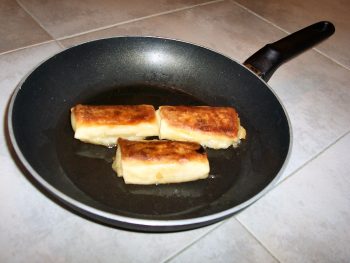
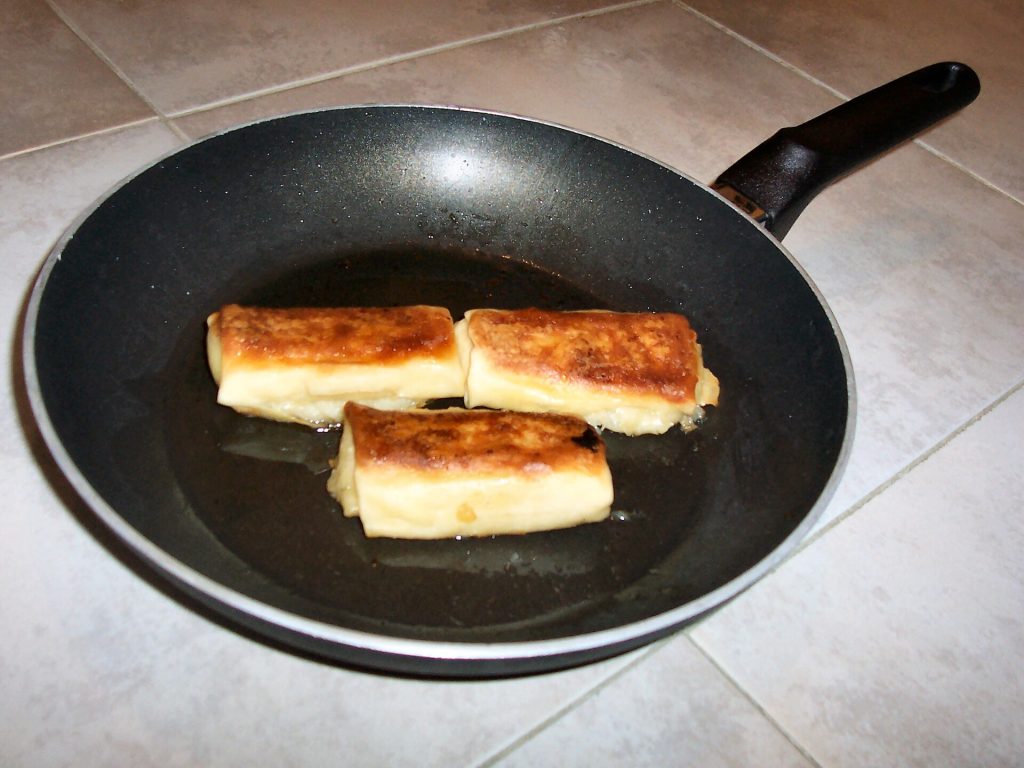
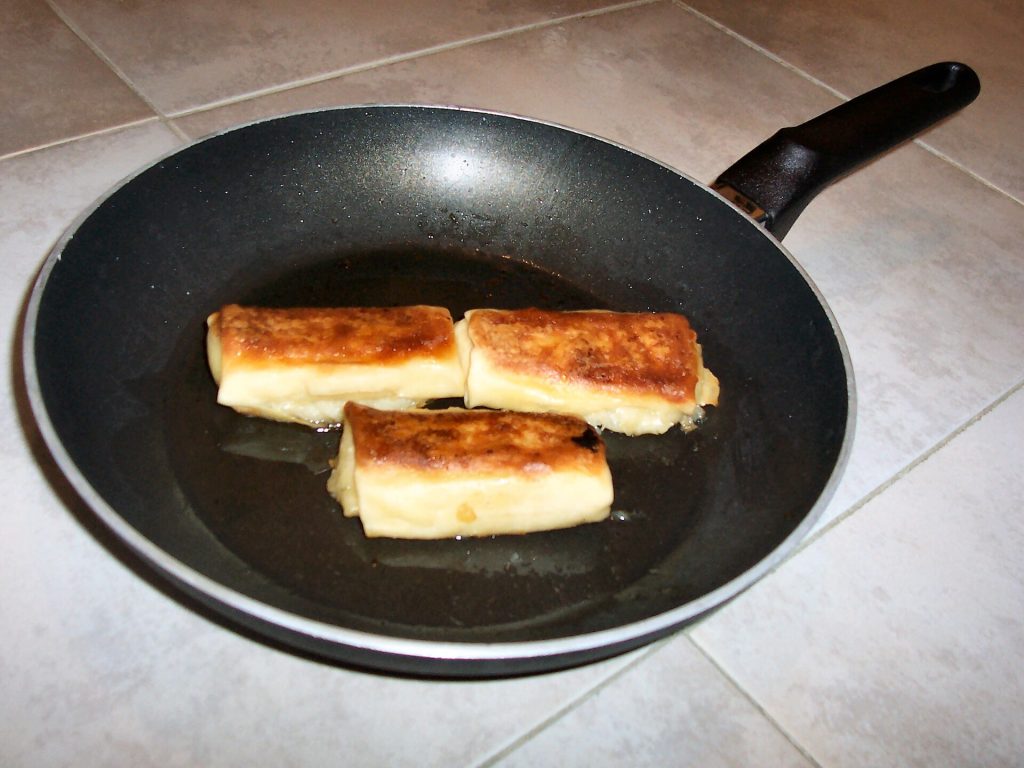
Featured photo: Blintzes in frying pan by Andrevan, BY-SA 2.5.