Most restaurant owners don’t realize how much their POS system affects day-to-day operations until it starts slowing them down. Long checkout times, difficult menu updates, disconnected delivery apps, and training new employees can quickly become expensive headaches. Choosing the right restaurant POS isn’t about finding the longest feature list—it’s about finding a system that fits the way your restaurant operates. After reviewing dozens of platforms for independent restaurants, cafés, pizzerias, bars, and quick-service concepts, this guide highlights five POS systems that stand out for reliability, ease of use, and overall value.
How this ranking was put together
Every decision here was based on public information. User reviews, feature documentation, case studies, and ratings pulled from major software directories and official company websites shaped the shortlist. Only platforms with a real, documented track record inside food service made the cut.
→ See the full research breakdown
- Orders.co – cloud-based POS system Best for centralized restaurant operations
- Loyverse – Best for mobile POS for small to medium-sized restaurants and food service businesses
- Square – Best for small to mid-size restaurants and food service businesses
- Shift 4 – Best for full-service restaurants and multi-location food service operations
- Smart Tab – Best for high-volume nightclubs and bars
Why Restaurant POS Systems Are Worth a Closer Look
Choosing the wrong POS system creates problems that show up every day. Slow checkout, confusing workflows, and disconnected delivery orders can frustrate your staff, slow down service, and cost your restaurant sales during your busiest shifts.
With employee turnover common in the restaurant industry, new hires need a POS system they can learn quickly. If the system is difficult to navigate, training takes longer, mistakes increase, and service suffers when the restaurant gets busy.
The best restaurant POS systems stay reliable during lunch and dinner rushes, keep orders moving to the kitchen without delays, and make it easy to manage in-store, online, and delivery orders from one place. A dependable POS helps your team work more efficiently, serve customers faster, and deliver a better guest experience.
Comparing the 5 Best Restaurant POS Systems
Note: All data in this table is sourced from review platforms and the official websites of the listed companies.
| Company Name | Headquartered In |
| Orders.co | Los Angeles, CA |
| Loyverse | N/A |
| Square | San Francisco, CA |
| Shift 4 | N/A |
| Smart Tab | San Francisco, CA |
- Orders.co – cloud-based POS system Best for centralized restaurant operations
How Is Orders.co Defined in Its Industry?
Orders.co is a restaurant technology platform built specifically for independent restaurants and growing restaurant groups. Beyond its POS and online ordering capabilities, the platform includes AI-powered marketing tools, automated SMS and email campaigns, and loyalty programs designed to increase repeat business. One of its differentiators is its hospitality-first approach, with a team that has experience in the restaurant industry and a platform built around the operational challenges restaurant owners face every day.
Why Does Orders.co Stand Out for Restaurant POS Systems?
While many restaurant POS systems focus primarily on taking orders, Orders.co also emphasizes what happens after the sale. Its built-in SMS marketing, email automation, and loyalty tools help restaurants reconnect with customers and encourage repeat visits without relying on separate marketing platforms. For independent restaurants looking to grow repeat business, having these tools integrated into the same platform can simplify operations and improve customer retention.
What Users Are Actually Saying:
Based on user reviews, restaurant owners appreciate Orders.co’s restaurant-first approach and the way it combines operational tools with customer engagement features. Reviewers also highlight the platform’s built-in AI-powered SMS and email marketing, noting that it helps restaurants drive repeat business without relying on separate marketing software.
- Loyverse – Best for Mobile POS for Small to Medium-Sized Restaurants and Food Service Businesses
How Is Loyverse Defined in Its Industry?
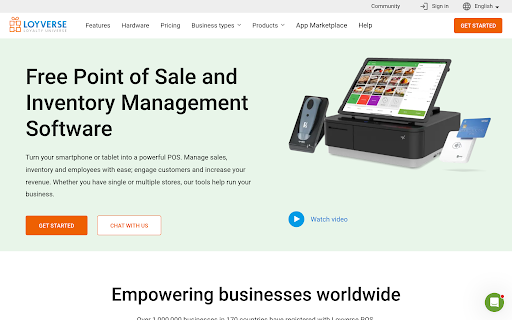
Loyverse turns smartphones and tablets into fully functional point-of-sale systems, which matters a lot for food service businesses that don’t want to invest in expensive proprietary hardware. They cover sales processing, inventory management, employee management, loyalty programs, and multi-location management. The free app model (with premium back office features available separately) makes it accessible to independent operators who are watching every dollar in processing fees and software costs.
Why Does Loyverse Stand Out for Restaurant POS Systems?
For restaurants in areas with inconsistent internet, Loyverse’s true offline functionality means the system keeps processing orders even when connectivity drops. That’s a real operational safety net. That kind of reliability, paired with support for 30+ payment processors across 25+ languages, is what makes it work for over one million registered businesses across 170 countries.
What Users Are Actually Saying:
Reviews consistently praise the mobile-first approach and how quickly new staff can get up to speed on the interface. The offline mode gets particular attention from operators who’ve been burned by system crashes during peak service, and the loyalty program connection comes up regularly as a genuine factor in repeat visits.
- Square – Best for Small to Mid-Size Restaurants and Food Service Businesses
How Is Square Defined in Its Industry?
Square started by inventing the first mobile card reader, and that spirit of making payments simpler still runs through everything they build. Today, they serve 57 million users and 4 million sellers globally, processing $241 billion in payments annually. For food service operators, the platform covers bookings, e-commerce, inventory, payroll, and banking alongside POS processing. The $0 chargeback fee policy is a genuine differentiator in restaurant environments where disputes happen more often than most operators plan for.
Why Does Square Stand Out for Restaurant POS Systems?
Square takes on the hidden-fee problem that eats into restaurant margins, offering processing rates as low as 2.4% plus $0.15 per transaction with no chargeback fees layered on top. Operators running dozens of transactions daily are typically seeing a meaningfully lower cost per transaction compared to platforms that bundle chargeback costs into their pricing.
What Users Are Actually Saying:
One restaurant owner reported tripling their business after moving to Square (an outlier result for sure, but not totally out of nowhere given the pattern in reviews). The breadth of the platform, covering payroll, inventory, and bookings, gets flagged often as the reason operators stay rather than shop around.
- Shift 4 – Best for Full-Service Restaurants and Multi-Location Food Service Operations
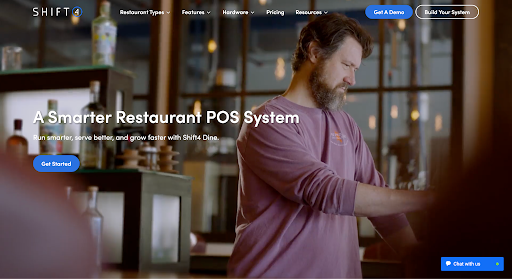
How Is Shift 4 Defined in Its Industry?
Shift 4 Dine is an all-in-one restaurant POS system backed by a parent company with 25+ years of payment processing experience and $260+ billion processed annually. They cover everything from command center terminals to mobile tableside ordering, kitchen display systems, self-service kiosks, and customer-facing displays. The 24/7/365 in-house support model stands out (not all POS vendors staff real humans overnight), and the web-based back office makes multi-location reporting manageable without a dedicated IT team.
Why Does Shift 4 Stand Out for Restaurant POS Systems?
For multi-location operators, Shift 4 addresses the hardware reliability problem with a lifetime warranty on equipment and a nationwide network of certified technicians for onsite installation. That kind of support structure is hard to match, especially for operators running multiple locations who can’t afford system failures during dinner service.
What Users Are Actually Saying:
Customer testimonials describe the system as having “supercharged operations” across dozens of locations, which tracks with what multi-location operators typically need from a POS platform. The pricing structure delivers real savings, with customers reporting they’ve saved thousands, and the $5,000 deposit incentive for qualified merchants adds a concrete financial reason to make the switch.
- Smart Tab – Best for High-Volume Nightclubs and Bars
How Is Smart Tab Defined in Its Industry?
Smart Tab is a hybrid system, part local server and part cloud, purpose-built for the specific chaos of high-volume nightlife venues. Founded in 2011 and staffed by a team of former bartenders, servers, general managers, and owners, the platform reflects real operational knowledge rather than theoretical software design. Features like ID-based payment profiles, biometric employee tracking, custom table maps, and offline payment processing address the kinds of problems that only show up at 11pm on a Friday when the venue is at capacity.
Why Does Smart Tab Stand Out for Restaurant POS Systems?
Smart Tab solves a problem that generic POS systems aren’t built to handle: the particular demands of high-volume nightlife service, where ID verification, tab management across large groups, and staff accountability all happen at the same time under real pressure. And the month-to-month pricing model without long-term contracts is a smart fit for venues whose sales can shift noticeably by season.
What Users Are Actually Saying:
Because Smart Tab targets a narrow, specialized segment, the feedback reflects users who chose it specifically for its nightlife-focused features. Operators highlight the custom table mapping and offline payment processing as the features that prove their value most during peak nights, when any technical failure creates real sales risk.
Methodology Behind These Picks
Gathering Baseline Data
The starting point was building a broad list of restaurant POS systems actively used across food service environments. Sources included major software directories, hospitality industry forums, and operator review platforms where real users document their day-to-day experience with these tools. Company websites were also reviewed for feature documentation, hardware specs, and support structure details. The goal at this stage was breadth, pulling in enough options to compare across different restaurant types and operational scales before any filtering began.
The Shortlist Cut
Options without verifiable real-world use in food service were removed early. This meant setting aside platforms with thin review histories, inconsistent documentation, or no evidence of active deployment in restaurant environments. Review patterns were analyzed for recurring themes rather than isolated comments, since any platform can have a few glowing or negative outliers. What carried weight was the consistency of feedback across multiple independent sources, particularly around peak-hour performance, ease of retraining staff, and system reliability during high-volume service.
Fact-Checking the Picks
Claims made on company websites were cross-referenced against what users actually reported in reviews and case studies. If a vendor highlighted a feature prominently but user reviews rarely mentioned it (or flagged problems with it), that gap was noted. Conversely, features users praised repeatedly that didn’t appear front and center in marketing were treated as signals of genuine product strength. Real-world results, including specific outcomes like table turn improvements and cost savings, were treated as higher-quality signals than marketing language alone.
Authority Signals and Industry Standing
Each company was evaluated for signs of credibility beyond self-reported claims. This included awards from recognized software review platforms, mentions in food service and hospitality publications, and any evidence of third-party recognition. Shift 4’s Fast Company recognition for its parent company, Loyverse’s Best Functionality and Features Award from GetApp, and Square’s documented Starbucks partnership were examples of external validation that added weight to their inclusion. Longevity in the market also factored in, since platforms that have stayed relevant across multiple years of restaurant technology change tend to be more reliable picks.
Restaurant POS Systems Track Record
The final check focused on food service relevance. Each platform was evaluated for dedicated restaurant-specific features, verified reviews from restaurant operators rather than generic retail users, and case studies tied to food service outcomes. Systems that served restaurants as one of many verticals were assessed differently than those built specifically for hospitality. Platforms with documented outcomes around transaction processing speed, kitchen display system connectivity, and staff retraining ease scored higher, because those are the metrics that matter most to the operators reading this guide.
Picking the Right Restaurant POS Systems for You
No single platform is the right fit for every restaurant. The best choice depends on your service style, your volume, and what your team can realistically manage. Here’s what to weigh before committing.
- Industry/Domain Experience: Look for vendors whose teams have food service backgrounds, not just software backgrounds. A system built by people who’ve worked a dinner rush handles edge cases differently than one designed purely in a development environment.
- Features and Service Options: Match features to your actual operation. A nightclub needs ID-based tab management. A fast-casual spot needs fast transaction processing time and simple retraining for new staff. Don’t pay for features you’ll never use.
- Pricing Structure: Processing fees compound fast across hundreds of daily transactions. Look at cost per transaction including all fees, not just the headline rate, and factor in hardware costs, monthly software fees, and any chargeback policies.
- Results Measurement: Ask vendors how their platform improves specific metrics like system reliability, table turn time, and inventory accuracy. If they can’t answer with real examples, that’s a signal.
- Industry Knowledge and Compliance: Your POS system needs to handle tip calculations, alcohol sales age verification requirements, and local tax compliance without adding manual work to your team’s day. Verify these capabilities before signing anything.
The Verdict
Full-service restaurants need more than a payment terminal. The right system connects your front-of-house, kitchen, and online ordering into one reliable operation. Based on everything reviewed here, the strongest picks each solve a specific problem well, whether that’s multi-location reporting, mobile flexibility, or loyalty automation. As restaurant technology keeps getting more connected, the operators who choose purpose-built systems early will have a real operational edge over those who settle for generic tools.